Practice Areas

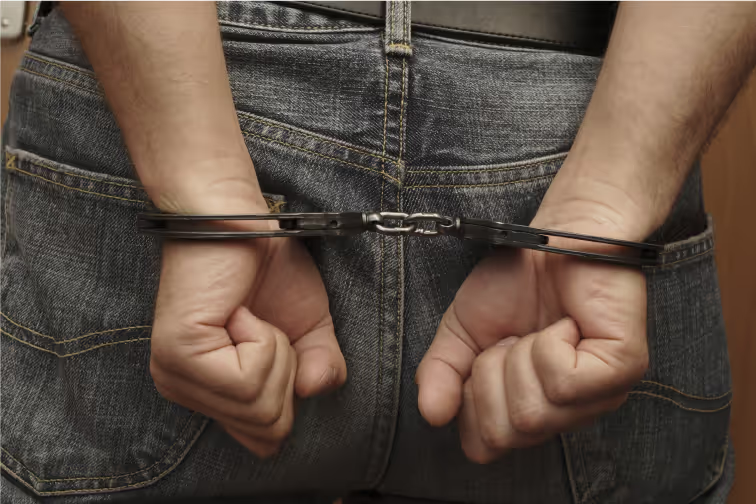
Common concerns after an OWI or criminal arrest.

The days following an arrest can be confusing and stressful. Deadlines arrive quickly, your license may be at risk, and the legal processcan feel overwhelming.

Risk of losing your license
Driving privileges can be suspended or revoked soon after an OWI arrest.
Urgent legal deadlines
You may have as little as 10 days to request certain hearings.
Potential jail time or criminal penalties
Penalties vary depending on the charge and prior offenses.
Threats to employment
A conviction may affect jobs, future opportunities, and professional standing.
Uncertainty about the legal process
Many clients have never dealt with the court system before.
Questions about the validity of the arrest
Traffic stops, sobriety tests, and procedures must follow strict rules.
Our Services

Expertise and experience on your side.

What you do next is crucial. Winning a case depends on the experience of your attorney and how the facts come in.

Talk to a lawyer
01
OWI Defense

Charged with an OWI in Wisconsin?

The decisions you make in the first days after an arrest can affect your license, your record, and your future. OWI cases often hinge on details: why the stop happened, how field sobriety tests were administered, and whether testing procedures followed proper standards. Identifying errors or weaknesses in the case can make a significant difference in the outcome.

We'll examine every step of the arrest and build a defense based on the facts.

Learn more
02
Criminal Defense

Criminal cases can change your life

The consequences of a conviction can follow you for years. Criminal charges may affect your freedom, employment opportunities, and reputation.

Every case begins with a careful review of the facts surrounding the arrest and the evidence involved. Identifying weaknesses in the case can make a meaningful difference in the outcome.

Learn more
03
Traffic Violantions

Received a traffic ticket in Wisconsin?

No violation is too small. What may seem like a minor citation can lead to larger problems if left unresolved. Traffic violations can affect your driving record, insurance rates, and in some cases your ability to keep driving.

We represent drivers facing a variety of traffic-related offenses and works to resolve citations while helping clients avoid further consequences.

We'll review the circumstances of the citation and determine the best path forward.

Learn more
Our Process

What happens when you contact Piel Law Office?

01
Free consultation
We begin by discussing the circumstances of your arrest or citation and answering your immediate questions.
02
Case review
We fight for our clients at every stage of the process. That means challenging evidence, questioning procedures, and pushing for the best possible resolution.
03
Defense strategy
Every case is fact-specific. Police reports, video footage, testing procedures, and timelines are carefully reviewed to uncover details that can make a difference.
04
Representation and resolution
Your case is handled through hearings, negotiations, or trial when necessary, with the goal of reaching the best possible outcome.

Client Testimonials

Clear communication

"I was always kept up to date about what was happening in my case."

Relentless representation

"Walt fought hard for me and negotiated a felony charge down to a dismissal."

Strong defense

"Two cases were dismissed and we won at trial. I highly recommend this firm."

Real results

"Got my refusal dropped and avoided three years of SR-22. Worth it."

Knowledgeable and prepared

"Walt knows exactly what he’s doing. He does his homework, explains things clearly, and gets straight to the point."

Professional and straight to the point

"They are professional tough as nails and not sugar coat anything. If you want to be defended the right way Attorney Piel is your best and only option period."

Decades of experience defending WI clients.

Our clients come to us during some of the most stressful moments of their lives. Because experience matters when you need results.

30+
Years defending clients in Wisconsin.
4.8
Average Google review rating.
99%
Clients report positive experiences.
4,000+
OWI and criminal cases handled.

Let's talk about your case

Enter your information below
By submitting, you agree to our Terms and Privacy Policy.
Thank you! Your submission has been received!
Oops! Something went wrong while submitting the form.

We'll protect you when a charge puts everything at risk.

Start with a no-cost consultation to discuss your situation and learn what options may be available.

Quick response.
You’ll hear from us soon so you’re not left guessing what to do next.
Clear next steps.
After our call, we'll provide you with a detailed plan.

Frequently Asked Questions

See all resources
What does the Notice of Intent to Suspend form mean?

The Notice of Intent to Suspend outlines the procedures for demanding the Administrative Suspension Hearing. Thus, this document is very important. In short, the Notice tells you that you have 10 or 13 days from the Notice date to demand an administrative suspension hearing. You have 10 days if the officer provided you with the notice in person or 13 days if the officer mailed the notice to you. For purposes of the administrative suspension hearing, only business days count. The hearing is demanded by filing the Administrative Review Request form. The officer should have provided this form to you. If you fail to timely demand the administrative suspension hearing, your license will be administratively suspended for 6 months. That suspension would start 30 days from the date on the Notice of Intent to Suspend Operating Privileges.

What happens at an Administrative Suspension Review?

The Administrative Suspension Hearing is an important part in fighting a drunk driving charge. It is a key opportunity to gather information related to the offense. You are allowed to obtain the police reports prior to the hearing, subpoena officers to the hearing, question the officers and tape record the hearing. In my experience, I have won cases based in part on the information that was obtained at the Administrative Suspension Hearing. Therefore, exercising your right to this hearing is critical. ​Additionally, if the DMV suspends your license after the hearing, I can file documents to attempt to stay the suspension during the pendency of the case. Some attorneys do not demand an Administrative Suspension Hearing, but I find it is an important tool in defending a case and to keeping a client’s license potentially valid while the case is pending and a determination is made by a jury or the courts as to their innocence or guilt. ​

Occupational License: How may hours can I drive per day/per week?

An occupational license will allow you to drive up to 12 hours per day but no more than 60 hours per week. Hours of operation must be submitted to the Wisconsin DOT on the application that is required to be submitted. The application breaks up the drive time into half-hour intervals. You are allowed to break up your hours of potential driving in this manner. Thus, you could literally drive every other hour (12 hours per day) for five day during each week (60 hours per week). Only actual drive time is counted. Thus, if it takes you an hour to get to work and an hour to get home, and then you work 8 hours (at a factory or office) all you would have to include on the application is the two hours of actual drive time. The time that you spend at work, not driving, does not have to be included. The DOT no longer issues occupational licenses for the operation of commercial motor vehicles. Finally, note that if you obtain an occupational license, you must operate only within the hours of that occupational. There are serious consequences, including possible jail, for operating outside your hours.

I refused testing and have a Notice of Intent to Revoke--what do I do?

When you are arrested for drunk driving, if you refuse to provide a chemical test of your breath, blood or urine, the officer should provide you with a document entitled Notice of Intent to Revoke Operating Privileges (Notice hereinafter). This document is very important, however often clients do not read this form. The Notice advises the arrestee that he has 10 days from the notice date on the form to demand a refusal hearing as part of challenging the drunk driving. If a hearing is not demanded within that 10 day period, the arrestee’s drivers license will be revoked for either 1, 2, or 3 years (depending on the number of prior violations) and will count as a drunk driving on the person's driving record. That revocation takes place 30 days after the notice date on the Notice of Intent to Revoke if you do not demand the hearing. To demand the hearing, the arrestee must file a WRITTEN request for a refusal hearing. Failure to file a written request within the 10 day period will be fatal to further defending your drunk driving and litigating the refusal allegation. If you are alleged to have refused to take a chemical test of your blood, breath or urine, your best bet is to contact an DUI attorney immediately.

Why did I receive a Notice of Intent to Revoke if I took the test?

Whether you refused to submit to a chemical test of your breath, blood or urine is a legal question. Providing a sample is not always determinative of whether there was a refusal. Prior to requesting a chemical test sample, an officer has an obligation to read you a form entitled the Informing the Accused form. The reading of the form is required under Wisconsin law. After the officer reads you the form, he will ask you whether or not you wish to submit to an evidentiary chemical test of either your breath, blood or urine. The officer is allowed to pick the type of the primary test. Anything less than an unequivocal "yes, I'll take the test", could be seen as a refusal. Furthermore, even if you refuse, the officer has the right to literally hold you down and draw blood from you. Many times the threat of this action is enough to get a person to agree to the test. The problem is you cannot cure an earlier refusal. Thus, if you initially refuse testing, but subsequently change your mind, for instance in response to the officer's threat to hold you down, and then give the sample, you could still be charged with refusing, even though in the end you actually submitted to the test. If the officer provided you with a document entitled Notice of Intent to Revoke Operating Privileges you have been charged with refusing. In this situation, it is critical that you immediately contact a qualified attorney. You have only 10 days from the date of the Notice to request a refusal hearing. If you fail to timely request the hearing, your license will be automatically revoked. Additionally, taking a breath test on the roadside does not satisfy your obligation to submit to testing under Wisconsin law. I often hear clients complain that the reason they refused testing at the station or hospital was because they had already tested over the legal limit on the breath test offered at the road side. The breath test offered on the road is called a preliminary breath testing (PBT) device. For purposes of Wisconsin law, it is inadmissible in all proceedings except at a motion challenging probable cause to arrest. It is not an evidentiary test. Unfortunately, by taking the PBT you have not complied with the Wisconsin Implied Consent law. In other words, the officer has the right upon arrest to request you to submit to an evidentiary chemical test of your breath even though you had previously submitted to a PBT on the road side. More importantly, refusing to submit to the request could be considered a refusal.

What does a jury trial mean and how do I have one?

The right to a jury trial is arguably your single most important right. In all OWI cases (except refusal proceedings) you have the right to have your case tried to a jury. In a criminal OWI case (OWI-2nd or subsequent, or causing injury or death by OWI), the right to a jury trial is automatic. The jury will consist of 12 people who must return an unanimous verdict. Before you ever reach the jury trial stage, Piel Law Office exhausts all avenues of investigation of your case and discusses potential defenses at trial to reach the best outcome for each of our clients.

Prior Convictions: What counts?

In Wisconsin, the law is extremely liberal in determining which prior convictions count. There are two specific look back windows. If there is a prior conviction within the last 10 years, the new violation will be considered a second offense. If there are two prior convictions since January 1, 1989, then the new violation will be a third offense. For purposes of third or subsequent offenses, the look back period is lifetime. However, when the legislature enacted the change in the law they decided to start your lifetime on January 1, 1989. Thus, only violations on or after January 1, 1989 count for the purpose of determining prior convictions. Convictions, revocations and suspensions from other jurisdictions and from recognized American Indian tribe jurisdictions also count. Also, refusal revocations from Wisconsin or other jurisdictions count. While the definition of conviction is very broad, not all prior convictions count. Thus, if you have a drunk driving related offense in another jurisdiction, it is critical that you contact a qualified attorney to determine if it can be counted in Wisconsin.

Work Release/Huber: Will I be able to work?

Work release is commonly referred to as Huber release privileges. When a county jail sentence is imposed most courts will allow work release privileges. Only in very limited cases will the court deny a client Huber release privileges. However, Huber rules are very strict and it is important to comply with all requirements to maintain your privileges. Unfortunately, if you are sentenced to prison, Huber release privileges will not be allowed. Furthermore, I have seen some jails refuse to release clients when the client's job involves serving alcohol. I have also seen jails refuse to release a client where the job involved driving a vehicle or where the client did not have transportation to his job.

Is Probation an Option?

Probation can be given in OWI 4th and subsequent cases. However, there is a minimum mandatory jail sentence that the probationer must serve as a condition of probation. Not all courts use probation in OWI cases. To determine if probation is an option, it is best to discuss your case with a qualified attorney.

Electronic Monitoring or House Arrest: Can I serve my sentence this way?

Whether house arrest (electronic monitoring) is an option depends on the county. Some jails always offer electronic monitoring, while others will never put a client on electronic monitoring. The judge or the prosecutor will play a significant role in whether the client is allowed to serve a sentence on electronic monitoring. Some judges will never order electronic monitoring. Others have no objection to it. Similarly, some prosecutors have no objection to electronic monitoring, while others are rabid opponents. In the end, the decision will fall on the jail. Note that some jails require a defendant to serve a portion of the sentence in jail before the defendant would become eligible for house arrest. To determine if this is an option you must contact a qualified attorney.

Our locations

Get in Touch with Us

Lorem ipsum dolor sit amet, consectetur adipiscing elit. Suspendisse varius enim in eros elementum tristique.

Talk to a lawyer
Phone
877.384.1384
Fax
920.390.2088
Email
wpiel@piellawoffice.com
Office Hours
Mon-Fri
8:30am-4:30pm
Sat-Sun
Closed
Milwaukee, WI
11414 W. Park Place, Ste. 202
Milwaukee, WI 53224
Watertown, WI
615 E. Main St. Ste. D
Watertown, WI 53094

Practice Areas

You've been arrested

What you do next is crucial. Winning a case depends on the experience of your attorney and how the facts come in. Our approach to defending anyone charged with drunk driving is to presume they are innocent, look for ways to present a defense, and finally, be direct and honest about the charges they face.

What happens next

1

Carefully review the paperwork you received when you were arrested. There are many deadlines and steps to take before your first court date.

2

Prepare a written account of the events leading up to and after your arrest. Include a timeline and a general description of your interaction with the police. Save your version of the events for a consultation with a qualified attorney.

3

Contact an attorney to discuss the facts of your case and your situation. If you decide to hire an attorney, be sure to find an experienced attorney that you feel comfortable with and can afford.

DUI Defense

How we defend you

Drunk driving cases require a competent attorney to review audio and video evidence, how the field sobriety tests were administered, blood/breath test results, and testing processes. Your attorney should thoroughly understand toxicology and the body's absorption and elimination of alcohol and know how medical conditions can affect testing. Attorney Piel has the same training in administering field sobriety tests as the arresting officer. He has the experience necessary to analyze your blood/breath test records to look for errors or inconsistencies in the testing procedures and to cross-examine expert witnesses.

Simply put, he has the experience you need to defend your case.

What you should know

+
I have been charged with a DUI. What does this mean?

You have been accused of driving while under the influence of alcohol and probably received two tickets; one for operating a motor vehicle while under the influence of an intoxicant and if your test result was above .08, above .02 in fourth offense or higher cases, a second for operating with a prohibited alcohol concentration. While you may not have felt too impaired to drive, an OWI can be charged when a law enforcement officer stops you and suspects imparement.

+
What do I have "10 days" to do?

If you receive a Notice of Intent to Suspend Operating Privileges or a
Notice of Intent to Revoke Operating Privileges, you have 10 days to act. Failing to demand either hearing impacts your operating privileges 30 days from your date of arrest. Failing to Demand a Refusal Hearing when receiving an Notice of Intent to Revoke is irreversible and counts as a OWI conviction regardless of what eventually happens with your OWI arrest. While failing to demand the Administrative Suspension Hearing is less detrimental, it deprives you of opportunity to question officers and
in most cases, receive critical information about your case in advance of court appearances.

+
What is an interlock device?

An Ignition Interlock Device, or an IID, is placed on your vehicle and requires you to blow into the machine before allowing you to start your vehicle. You are also prompted to blow while driving, and any alcohol in your system will prevent the starting of your vehicle or will disable your vehicle.

+
Will I go to jail?

If you are charged with an OWI 2nd or subsequent charge, or there was a minor in the vehicle, injury or death on a first offense, jail will be imposed. The amount of jail time, or prison time in fourth offense cases or higher, varies based on the sentencing guidelines throughout the state and the circumstances of your case.

Criminal Defense

Criminal cases can change your life

A conviction can mean possible job loss or future employment issues. The consequences for felonies are even more severe, with voting rights and firearm rights at stake. We investigate your case to determine if your rights were violated and if an investigator is needed to interview witnesses. We’ll explain to you the potential penalties you face.

Attorney Piel has represented those charged with battery, disorderly conduct, drug charges, and sexual assault. Each case requires a thorough examination of the facts leading up to the arrest and an understanding of how to best defend our clients.

What you should know

+
I don't think I was read my Miranda rights?


+
What is the difference between a felony and a misdemeanor?


+
Need another quesiton re criminal cases


+
Is probation or a deferred agerement an option?

NEed Walt to write this

+
Will expungment be an option?

need walt to answe this

Traffic Violations

No Violation is too small

Traffic violations are not always just a minor inconvenience, especially if you drive for a living or have a probationary license. With so much at stake, it's important to consult with a lawyer who understands how these violations may impact you. We are well-versed in the process of resolving traffic citations. We will work diligently to help you reach an agreement that helps reduce the risk of other issues.

Client testimonials

"Walter was compassionate yet realistic regarding my situation. He explained every step of the process in ways that I could understand, took nothing for granted, and wound up getting the charges dismissed."

"Walter represented me with an aggressive no-quit attitude. He took charge and never misrepresented what he was willing to do or could do for my situation. Walter was always very patient with all my questions and I felt like I could call with anything that was not clear to me."

"Walter was always very patient with all my questions and I felt like I could call with anything that was not clear to me."​

"·      Attorney Piel handled my case in a professional and expeditious manner. I was very satisfied with his representation of me and completely resolved my case." 

"I was involved in a car accident after I had been drinking. The police charged me with two felonies. Walt came to my house and drove all the way across two counties to sit at my kitchen table and hear my story about that night. He made no promises, but I could hear a very strong, solid, reliable, honest, trustworthy, experienced man sitting
in front of me speaking. I immediately retained his services.
That was the best decision I ever made."

“Even knowing that was one of the worst days I’ve been a part of, you really made me feel like you had my back. Watching you go to work was a very impressive to witness.”

We begin with the presumption of innocence.

Get in Touch with Us

Milwaukee
11414 W. Park Place, Ste. 202
Milwaukee, WI 53224
Watertown
615 E. Main St. Ste. D
Watertown, WI 53094
Phone
877.384.1384
Fax
920.390.2088
Email
wpiel@piellawoffice.com
Office Hours
Monday
9:00 am - 5:00 pm
Tuesday
9:00 am - 5:00 pm
Wednesday
9:00 am - 5:00 pm
Thursday
9:00 am - 5:00 pm
Friday
9:00 am - 5:00 pm
Saturday
CLOSED
Sunday
CLOSED